By Dr. Kathleen Tate | 09/04/2026
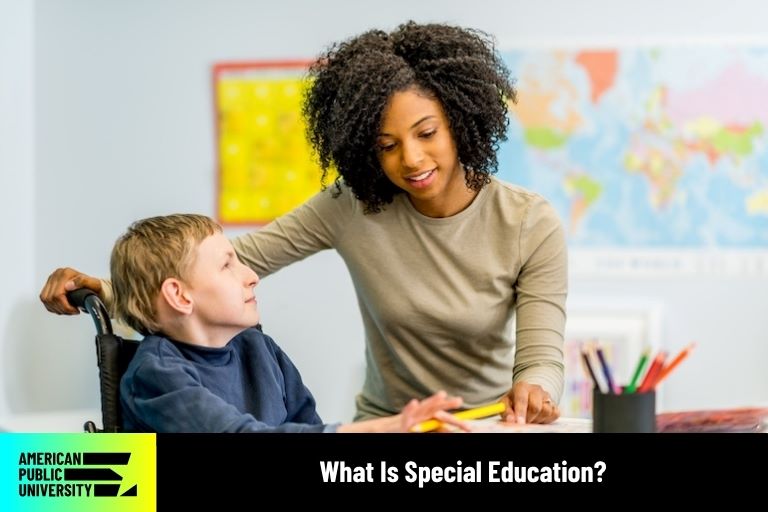
To understand students with disabilities’ needs and legal rights, educators and educational leaders should have a solid working knowledge of special education. The number of students requiring special education generally increases over time.
For instance, the National Center for Education Statistics reported that 7.5 million public school students with disabilities (approximately 15% of all public school students) “received special education and/or related services” between 2022-2023. These students ranged in age from 3 to 21 and among them, 32% had specific learning disabilities.
Similarly, the Advocacy Institute stated that the number of students with special needs increased by 3% in 2024.
How Federal Law Governs Special Education Services
According to the 1975 Individuals with Disabilities Education Act (IDEA), eligible students with disabilities can receive free special education and related services at public expense. IDEA has 13 disability categories that include:
- Autism Spectrum Disorder (ASD)
- Deaf-Blindness
- Deafness
- Emotional Disturbance
- Hearing Impairment
- Intellectual Disability
- Multiple Disabilities
- Orthopedic Impairment
- Other Health Impairment
- Specific Learning Disability
- Speech or Language Impairment
- Traumatic Brain Injury
- Visual Impairment (including blindness)
Based on the referral of a suspected disability, a school psychologist completes a comprehensive evaluation. The outcome of that assessment is then examined by a team (including the school psychologist) at the school to determine the student’s eligibility under IDEA. If the student is eligible, special education services must be provided to comply with this federal law.
Special education services, funding, and legal guidelines are complex for parents, educators, and educational leaders. But there are some basic aspects of special education that teachers and principals should understand whether they are new or long-term professionals in the field.
Understanding Special Education
The U.S. Department of Education defines special education as “specially designed instruction, at no cost to the parents, to meet the unique needs of a child with a disability.” This type of education includes instruction conducted in these locations:
- School classrooms
- Homes
- Hospitals and institutions
- Other settings, such as indoor/outdoor physical education areas
IDEA authorizes grant programs and funding that support special education as well as early intervention services for children with disabilities, as long as certain conditions are met. The purpose of these conditions is to provide certain educational and procedural guarantees for children with disabilities and their families.
Special Education Requirements Under IDEA
There are several conditions that schools must meet to provide special education, per IDEA. These conditions include:
- A Free Appropriate Public Education (FAPE)
- An Individualized Education Program (IEP)
- Identification and evaluation of students with a disability
- A Least Restrictive Environment (LRE)
- Procedural safeguards
FAPE
Schools are responsible for providing a FAPE to students with disabilities, including those students who have been suspended or expelled from school. Courts have established that students with disabilities must receive a meaningful educational benefit through an appropriate education, and that does not necessarily mean the best education. Examples of court cases include:
- Board of Education of Hendrick Hudson Central School District v. Rowley (1982)
- Endrew F. v. Douglas County (2017)
The focus is on sufficiency – a sufficient education with more than minimal progress.
IEP
For each student with a disability, there is a team who helps develop an IEP. This team typically includes:
- The student (sometimes)
- The parents
- A special education teacher
- A classroom teacher
- A school counselor
- The principal
Participants of the IEP team may vary. For example, a district special education director, a speech pathologist, or another service provider may join the team to help evaluate progress, identify or alter goals, and help address any problems if they occur.
The IEP includes a written plan. The student’s parents have the right and obligation to speak up about any concerns as the plan and the program are developed. The IEP should include:
- The services provided for the student’s unique needs
- Learning or behavioral objectives
- The placement and time spent in it
- Classroom and testing accommodations
- Resources such as assistive technology
- Related services, including transportation if needed
- Measurable goals
Special related services and materials are included under FAPE at no cost to parents or caregivers.
IEP Meetings
The evaluation process requires that the individualized education program team meets annually to review:
- The student’s goals and progress
- The student's placement (whether in general education or special education classrooms, such as a resource room)
- Specially designed instruction
- The student’s overall academic performance
Every three years, the IEP team holds a triennial review meeting to determine if the student’s needs have changed. Data and student artifacts should be examined to check if:
- The student has made adequate progress with learning and behavior goals.
- The services provided to the student should be adjusted.
- A dismissal from special education programming is needed.
Least Restrictive Environment
The student’s placement must be in a least restrictive environment per federal law. Students with disabilities should spend the maximum time possible with their non-disabled peers in the general education classroom. Necessary services and support may be provided to meet students with disabilities’ individual needs so that they have the access and opportunity to participate in a more mainstream classroom setting.
Offering support for students with special needs to participate in an environment with their peers who do and do not have disabilities helps prepare them for the typical community they will experience outside of school.
To meet the individual needs of students and deliver special education services as outlined in the IEP, educators must be aware of the appropriate and required accommodations. These accommodations allow students’ participation in classroom learning without altering the curriculum, which is vital for student success.
There are four accommodation categories, such as:
- Presentation – how an assignment, assessment, or test is given to students and how it removes barriers to learning (including providing alternate access modes through various senses such as touch or sight)
- Response – how students with disabilities express their learning through varied formats in activities, assignments, assessments, or tests with or without assistive devices
- Seating – how a location or conditions for activities, assignments, and assessments needs altering
- Timing/scheduling – if time needs to be increased for completing assignments and assessments or if structured breaks need to be allowed, for instance
Procedural Safeguards
The procedural safeguards explain parents’ rights and responsibilities. They must be provided to families once per year and for:
- An initial referral or request for evaluation
- The first time filing a due process hearing complaint or special education complaint during a school year
- A disciplinary change of placement
- A request from a parent
Schools are responsible for giving parents a copy of these procedural safeguards, which must be in their native language. Typically, school districts or the state provide translated versions.
Although a printed notice of procedural safeguards is given to parents, they also have the right to ask for a verbal explanation. Unfortunately, the procedural safeguards are written at an 11th-grade level or higher, and many parents may only have a middle school education or higher.
School staff, leaders, and specialists who attend IEP meetings and work with parents must be familiar with the procedural safeguards. They should also be able to answer parents’ questions accurately.
For parents, other key rights regarding procedural safeguards include:
- Participating in individualized education program meetings
- Having access to their child's educational records
- Providing informed consent or parental consent
- Receiving prior written notice (such as before changes to a student’s special education services)
- Using dispute resolution options (such as mediation)
This list is not an exhaustive list of parental rights, but it includes some of the most important ones.
Accommodations That Support Students in Special Education
For teachers, leaders, parents, students, and other members of the IEP team, appropriate accommodations should be personalized to students’ needs. Examples of learning environment accommodations for some disability categories for activities and assessments include:
Specific learning disability, blindness, and low vision
- Audiobooks
- Reading aloud
Highlighted text, and extended time (specific learning disability, blindness, and low vision)
Autism Spectrum Disorder, emotional disturbance
- Noise-cancelling headphones
- Quiet corner desks or spaces
- Seating in low-traffic areas
- Hourly schedules
- Calming stress toys
Intellectual disability
- Repetition and presenting material in threaded ways
- Chunked information and simple steps with visuals and highlighted text
These accommodations represent a small sampling of approaches to help with access to instruction regardless of a student’s disability. Educators may want to keep lists of accommodations to have ready for IEP meetings to better contribute recommendations to the team.
Appropriate accommodations help support the selected IEP objectives and special education services for students with disabilities. They enable students with disabilities to progress in their placement in special education classrooms, a resource room, or another setting while also leveraging their strengths or abilities.
Special Education Resources for Educators and Families
There are several vital resources to help educators and others to effectively aid students who receive special education services. These resources include:
- National Association for the Education of Young Children® (NAEYC®) – offers advice on the IEP process
- Special Needs Alliance® (SNA®) – provides IEP meeting tips for parents and students
- National Education Association (NEA®) – offers guidance on the evaluation process in special education
- Individuals with Disabilities Education Act – provides information about Least Restrictive Environment requirements and information for parents and students
- Center for Parent Information & Resources – offers more information about special education accommodations
The Master of Education in Teaching at APU
Note: American Public University’s Master of Education in Teaching is not designed to lead to certification or licensure. In order to make an informed decision about your education prior to applying here, we strongly encourage you to explore any state-specific or other requirements applicable to you, including certification, licensure, and certificate enhancements.
For interested adult learners who seek to teach special education students or gain the knowledge to seek leadership opportunities, American Public University (APU) offers an online Master of Education in Teaching. In this degree program, students can enroll in courses such as maximizing student achievement through effective assessment, classroom management for the 21st century, and co-teaching and collaboration for all learners. Other courses include different perspectives on teaching and communicating and powerful technology applications for the active learning environments.
This master’s degree offers eight concentrations to enable students to take the courses best suited to their professional interests. Master’s students with an interest in teaching students with disabilities may wish to take the courses for the Special Education concentration or the Autism Spectrum Disorder concentration.
For more information, visit APU’s education degree program page.
Note: This program has specific admission requirements.
National Association for the Education of Young Children® and NAEYC® are registered trademarks of National Association for the Education of Young Children.
Special Needs Alliance® and SNA® are registered trademarks of Special Needs Alliance, Inc.
NEA® is a registered trademark of National Education Association.
Dr. Kathleen J. Tate is a Professor and Department Chair of Teaching in the School of Arts, Humanities, and Education at American Public University part of American Public University System. She is an experienced university administrator, researcher, and the former Editor-in-Chief of the Journal of Online Learning Research and Practice (2016 – 2024). Kathleen is also the author of the children’s books “Melvin and Muffin: Physics on the Playground (Exploring Newton’s 3rd Law)” and “Cookiekins and Friends Go to the Park.” She studied six languages and learned Braille.
Kathleen has 29 years of experience working in higher education (Research I, online/hybrid, and other institutions) and K-12 special education, in addition to corporate, civil service, and retail experience. She has chaired and served on dissertation and Ed.S. committees, mentored faculty members, written and received internal and external grants (science education/technology education), and developed curriculum, especially integrating technology.
She holds a B.A. in Soviet and East European Studies with a minor in Economics and a M.Ed. in Special Education from the University of Texas at Austin. In addition, Kathleen has several lifetime Texas teacher licenses (1st-8th Elementary Education, PK-12th Special Education, and 1st -8th Theatre Arts) through the University of Texas at Austin. She has a Ph.D. in Elementary Education from Florida State University.
Kathleen’s research focuses on underserved populations, humane education, integrated/thematic/arts-based/multimodal teaching and learning, and STEAM (STEM + the arts). She served on the Curriculum Advisory Board for the Institute for Humane Education from 2019-2023. Kathleen has published articles in Teacher Education and Practice, Social Studies Research and Practice, Youth Theatre Journal, Science and Children, GATEways to Teacher Education, and the Journal of the Research Association of Minority Professors, to name a few.