10/20/2026
Exploring the Courses, Skills, and Typical Career Paths in Biology
Biology is the study of living organisms and the systems that support life. A biology degree typically gives students the opportunity to examine life at multiple levels, from cells and genes to animals, plants, ecosystems, and the wider natural world.
Students considering a biology program may be interested in scientific research, healthcare, environmental science, biotechnology, conservation, or graduate school. The degree may also appeal to learners who enjoy asking questions, analyzing evidence, conducting experiments, and understanding how scientific discoveries connect to real-world problems.
Explore what students study in a biology degree, how the coursework is structured, the skills they may develop, and the typical career paths connected to the biological sciences.
Understanding a Biology Degree
A biology degree combines scientific theory with practical investigation. Students typically learn how living systems function, interact, reproduce, adapt, and respond to their surroundings.
Biology majors tend to also study related sciences because biological processes cannot be understood in isolation. Chemistry helps explain reactions within cells. Physics provides insight into movement, energy, and biological systems. Mathematics and statistics support data analysis, research, and scientific decision-making.
The exact content of a degree in biology depends on the school, degree level, and concentration selected.
What Do Biology Majors Study?
A bachelor’s degree in biology typically begins with foundational biology courses before progressing into more specialized subjects.
Common areas of study might include:
- Cell biology
- Genetics
- Molecular biology
- Ecology
- Evolution
- Microbiology
- Anatomy and physiology
- Organic chemistry
- Physics
- Statistics
Students may explore how genetic information is passed between generations, how cells produce energy, and how organisms interact within ecosystems. They may also examine issues such as climate change, biodiversity, public health, and the effects of human activity on natural resources.
Lab Work, Research, and Data Collection
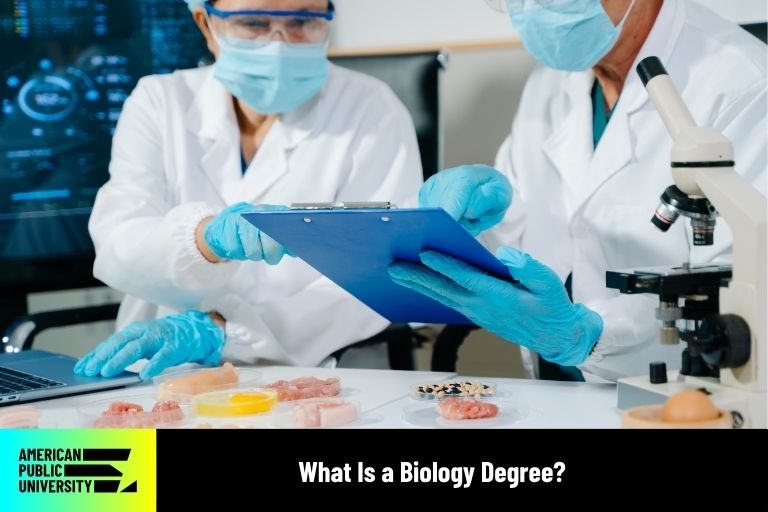
Lab work is an important part of studying biology because it gives students the opportunity to apply scientific concepts. Laboratory activities may involve observing biological samples, testing hypotheses, recording measurements, evaluating results, and presenting findings.
Many online biology programs integrate professionally designed virtual labs into their courses. Students use these exercises to explore scientific methods, practice data collection, and examine biological processes in a structured setting.
Some biology programs conclude with a research-focused capstone. Students may design an original research study, apply the scientific method, and communicate their findings. These projects allow undergraduate students to bring together the knowledge gained throughout their degree.
Depending on the program, biology students may also participate in field research, internships, independent projects, or studying abroad opportunities. These experiences may help students explore their academic interests in a different setting.
Biology Degree Concentrations
A general biology degree typically provides broad exposure to the life sciences. Some students may prefer a concentration that allows them to focus on a more specific subject.
Depending on the institution, a Bachelor of Science in Biology may offer concentration options such as:
- General Biology
- Preprofessional Health Studies
- Synthetic Biology
The General Biology concentration may suit students who want to study a broad range of biological subjects. Preprofessional Health Studies may appeal to students considering medical school, graduate programs, or other health sciences pathways. Synthetic Biology typically examines areas connected to genetic engineering, molecular biology, and the design of biological systems.
Students should review the courses within each concentration carefully and consider how they relate to their career goals or plans for further education.
What Skills May Students Develop?
Biology is not limited to memorizing scientific terms. Students are usually expected to interpret evidence, assess competing explanations, and communicate findings clearly.
A biology degree may help students develop:
- Critical thinking
- Scientific literacy
- Data analysis
- Problem-solving
- Research skills
- Scientific writing
- Time management
- Attention to detail
- Science communication
- Teamwork
Biology students often learn how to formulate and test scientific hypotheses using laboratory and quantitative methods. They may also practice communicating with scientific and non-scientific audiences, skills that can be valuable in research, education, public health, environmental work, and other biology-related fields.
Typical Career Paths for Biology Majors
A biology degree may relate to several professional fields. The positions available to an individual depend on their concentration, work experience, location, certifications, and education level.
Environmental Science and Conservation
Students interested in ecosystems and natural resources may explore environmental science, conservation, wildlife management, or ecology.
Environmental scientists may collect samples, analyze environmental data, investigate pollution, or study the effects of development on ecosystems. Some positions may involve office-based analysis, while others include field research and data collection.
Healthcare and Public Health
Biology provides a scientific foundation that may support further study in healthcare, public health, medicine, or related disciplines.
Some biology majors might use their undergraduate degree as preparation for medical school or a graduate degree. Others may explore work in health education, laboratory settings, public health programs, clinical research, or healthcare administration.
Additional education, certification, or licensure may be required for many health-related roles.
Biotechnology and Laboratory Science
Biotechnology typically applies biological science to the development of products, processes, and technologies. Work in this field may involve genetics, pharmaceuticals, agriculture, laboratory testing, or quality assurance.
Students interested in biotechnology may benefit from coursework in molecular biology, chemistry, statistics, and synthetic biology. Research experience and lab work may also help them understand how scientific findings are tested and documented.
Research and Education
Biology graduates may also explore scientific research, science communication, or education.
Research assistants and laboratory technicians may support experiments, prepare samples, record results, or maintain research equipment. Advanced research positions might require a master’s degree, doctorate, or other advanced degrees.
Students interested in teaching should review the certification and licensure requirements for their state. Some natural sciences degree programs may satisfy science-content requirements established by professional organizations; however, they are not necessarily teacher-preparation programs and may not lead to licensure. Requirements vary by state and institution.
Bachelor’s and Advanced Degrees in Biology
A bachelor’s degree typically provides a foundation in the biological sciences. It may prepare students to explore entry-level roles, graduate school, or professional programs, depending on the requirements of the next step.
Students who want to specialize further might consider pursuing a master’s degree, doctorate, or professional degree. Graduate programs may focus on subjects such as molecular biology, environmental science, marine biology, genetics, biotechnology, public health, or ecology.
Students considering genetic counseling, medical school, or advanced scientific research should review the admission requirements for those programs early. Some may require specific biology courses, organic chemistry, laboratory experience, or standardized examinations.
Is Biology a Good Major?
Biology may be a good major for students who are curious about living systems and comfortable working with scientific evidence. It typically requires careful reading, lab work, data analysis, and sustained study across several scientific subjects.
Before choosing a program, students may want to consider:
- Which areas of biology interest them most
- Whether they enjoy laboratory or field research
- Whether their goals require graduate school
- Which concentration best fits their academic interests
- How much chemistry, mathematics, and physics the program includes
- What practical research opportunities are available
Reviewing the full curriculum might help students understand what the degree involves before enrolling.
Choosing a Biology Degree Program
Biology degree programs vary by institution, but many require approximately 120 credits for completion. Some colleges and universities also allow eligible students to transfer previously earned credits, subject to institutional policies.
An example of possible courses include General Biology I with Lab, General Chemistry I with Lab, Elements of Physics I with Lab, and Statistics. Together, these subjects provide a foundation for studying living organisms, conducting research, analyzing data, and solving scientific problems.
Before enrolling in a biology degree program, students may want to consider their academic interests, long-term goals, and the types of learning experiences they value most. Reviewing the curriculum and course descriptions can provide a better understanding of what the program covers and how it supports their educational objectives.
Biology Degree Frequently Asked Questions
What do you do in a biology degree?
Students typically study living organisms, biological systems, genetics, ecology, chemistry, physics, and research methods. Coursework may include virtual or physical labs, data analysis, scientific writing, and a final research project.
What is a biology degree good for?
A biology degree may support further study or typical paths in environmental science, biotechnology, laboratory research, public health, education, or healthcare-related fields.
What jobs do biology majors get?
Biology majors might explore roles such as laboratory technician, research assistant, environmental science technician, science writer, quality assurance analyst, or public health worker. Requirements vary by position.
Do biology careers require graduate school?
Some entry-level roles accept a bachelor’s degree, while specialized research, medical, academic, and clinical roles may require a graduate or professional degree.