By Dr. Jessica Sapp | 09/01/2026
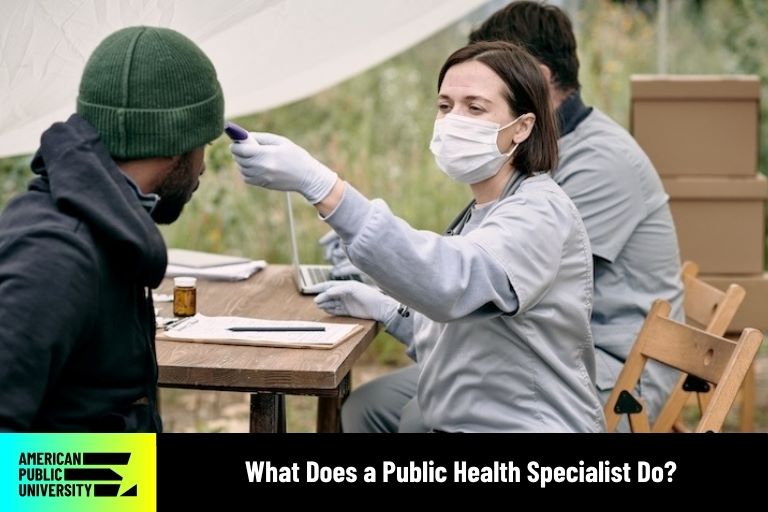
Public health specialists typically do work that involves five main areas of specialization. These areas include epidemiology, biostatistics, health policy, environmental health, and health education and promotion.
Epidemiology monitors disease distribution and prevention methods. Biostatistics uses mathematics to analyze public health problems.
Health policy involves developing and analyzing health policies. Environmental health focuses on pollution and food safety issues; health promotion educates communities on healthier lifestyle choices.
These five areas of public health encompass a broad scope, which is why what public health specialists do is very diverse. Public health specialists can work in health education, public health research, healthcare, or state government, to name a few.
Public Health Specialist Roles and Responsibilities
The work that public health specialists perform directly depends on various factors, such as their skills, experience level, and workplace. Public health specialists have different responsibilities according to their area of specialty, such as:
- Health education and promotion – According to the World Health Organization (WHO), “Health promotion is the process of enabling people to increase control over and to improve their health.” To contribute to this process, health educators promote healthy behaviors and disease prevention for individuals and families.
- Epidemiology – Epidemiologists monitor disease distribution and prevention methods. They can work in various environments. According to the U.S. Bureau of Labor Statistics, “Epidemiologists work in offices and laboratories, usually at health departments for state and local governments, in hospitals, and at colleges and universities.”
- Biostatistics – Public health specialists analyze health data to identify disease trends. In this role, strong analytical skills are crucial.
- Health policy and management – Public health specialists help develop and advocate for health policies. They may collaborate with lawmakers on health legislation to get policies implemented at the state or federal levels. Healthcare managers may also oversee healthcare systems and manage budgets.
- Environmental health – Environmental health specialists protect public health by identifying, evaluating, and controlling environmental factors that can cause illness. These environmental factors include food safety, water quality, hazardous materials, air pollution, and industrial hygiene.
Career Paths for Public Health Specialists
| Career Level | ||
|---|---|---|---|
Public Health Discipline | Entry-Level Job | Mid-Career Job | Senior-Level Job |
Health Education and Promotion | Health Educator | Public Health Program Manager | Wellness Director |
Epidemiology | Epidemiology Research Assistant | Epidemiology and Evaluation Manager | Chief State Epidemiologist |
Biostatistics | Data Analyst | Senior Biostatistician | Director of Biostatistics |
Health Policy and Management | Medicaid Analyst | Public Health Policy Program Specialist | Health Policy and Programs Manager |
Environmental Health | Environmental Health Specialist | Environmental Health & Safety Manager | Vice President, Environmental, Health, and Safety |
How to Become a Public Health Specialist
There are various requirements to becoming a public health specialist. A college education, public health internships, and professional certifications (in some cases) are needed to seek a career path as a public health specialist.
Education Requirements for Public Health Specialists
Most public health careers require some form of education; it is rare to find employers that will hire you with only a high school diploma in the public health sector. Usually, a bachelor’s degree in public health is required to become a public health specialist. Graduate degrees are often needed for more advanced positions in this industry.
When you study public health at the undergraduate level, you will be introduced to all core areas of public health. You’ll learn the same core areas at the graduate level, too, but you’ll also have the opportunity to specialize in a particular public health area.
If you want to pursue more advanced job postings in health promotion, then you may want to consider a master’s degree. Examples of these degrees include a Master of Science in Public Health or a Master of Public Health (MPH).
Regardless of which specialty you pursue, selecting an accredited program is important to your career goals. Many public health jobs require a master’s degree from a Council on Education for Public Health® (CEPH®) accredited program.
Why Public Health Internships Matter
Many bachelor’s and master’s public health degree programs require an internship to complete your degree. Internships provide practical experience in public health occupations. They are an incredible opportunity because you will gain some professional experience and valuable job skills before you even graduate.
When I was earning my bachelor’s degree, for example, I interned at NASA’s Kennedy Space Center (KSC) in their health education and wellness program. This internship was essential for gaining practical public health experience and providing assistance and support to people who needed it. It also opened up many career opportunities, including my later position as the Wellness Manager at KSC.
As the Wellness Manager for KSC, I also had the chance to serve as the Medical Triage Communicator for the space shuttle program. Even though this role was a small percentage of my job, it was a once-in-a-lifetime experience to be part of America’s space program. And it all started with an internship!
Professional Certifications for Public Health Specialists
Because there are many public health specialties, there are also many types of certifications. Each public health specialization has its own certifications that are recognized in the field.
Here are some examples of some certifications:
- Certified in Public Health (CPH) – This certification is administered by the National Board of Public Health Examiners (NBPHE®).
- Certified Health Education Specialist (CHES®) – This health education and promotion certification is administered by the National Commission for Health Education Credentialing (NCHEC).
- Certified Analytics Professional® (CAP) – This certification is administered by the Institute for Operations Research and the Management Sciences (INFORMS®).
- Certified in Infection Control (CIC®) – This epidemiology certification is administered by the Certification Board of Infection Control and Epidemiology (CBIC®).
- Professional, Academy for Healthcare Management (PAHM®) – This healthcare management certification is administered by America’s Health Insurance Plans® (AHIP®).
- Fellow of the American College of Healthcare Executives (FACHE®) – This healthcare policy and management certification is administered by the American College of Healthcare Executives® (ACHE®).
- Certified Industrial Hygienist® (CIH®) – This environmental health certification is administered by the Board for Global EHS Credentialing® (BGC®).
Why Public Health Specialists Are Important to Community Health
Public health specialists are essential to society because they help implement different health programs. Through health interventions and initiatives, public health specialists can reduce disease incidence and improve population health outcomes for both local and global communities.
The Bachelor of Science in Public Health at APU
For students interested in public health and other related topics, American Public University (APU) provides an online Bachelor of Science in Public Health. For this degree program, students can enroll in courses such as public health in America, health economics and finance, and health services organization. Other courses include leadership and motivation, epidemiology, and public policy.
For more information, visit APU’s nursing and health sciences program page.
Council on Education for Public Health® is a registered trademark of Council on Education for Public Health.
NBPHE® is a registered trademark of National Board of Public Health Examiners.
CHES® is a registered trademark of National Commission for Health Education Credentialing, Inc.
Certified Analytics Professional® and INFORMS® are registered trademarks for Institute for Operations Research and the Management Sciences.
CIC® and CBIC® are registered trademarks of Certification Board of Infection Control and Epidemiology, Inc.
PAHM®, America’s Health Insurance Plans®, and AHIP® are registered trademarks of America’s Health Insurance Plans, Inc.
FACHE®, American College of Healthcare Executives®, and ACHE® are a registered trademark of American College of Healthcare Executives.
Certified Industrial Hygienist®, CIH®, Board for Global EHS Credentialing®, and BGC® are registered trademarks of Board for Global EHS Credentialing.
Dr. Jessica Sapp is a faculty member in the School of Health Sciences at American Public University part of American Public University System. She has over 20 years of experience in public health, working in various environments including government, hospitals, health insurance, community, international, corporate, and academia. She is the author of various books, including “Your Healthcare Job Hunt: How Your Digital Presence Can Make or Break Your Career.”
Dr. Sapp has a B.S. in Health Science Education from the University of Florida and an MPH in Health Promotion, Education and Behavior at the University of South Carolina. She earned her Doctor of Public Health in Health Policy and Management from Georgia Southern University.