By Dr. Matthew Loux and Bryce Loux | 04/14/2026
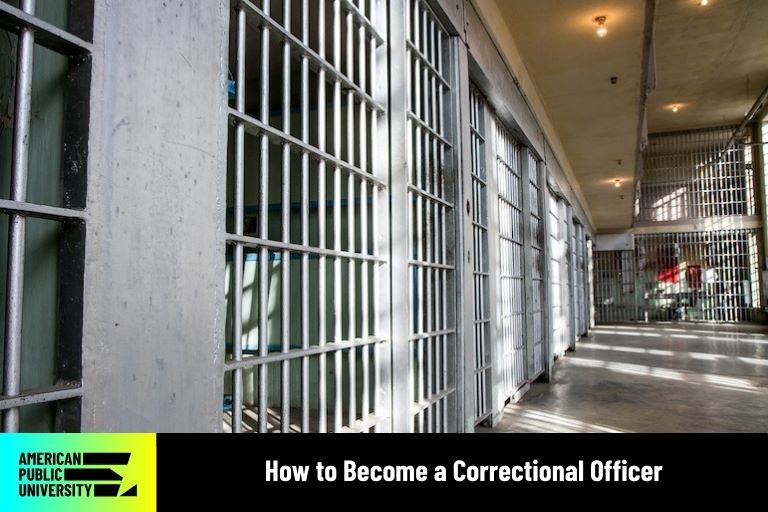
To ensure public safety as well as security and order in correctional facilities, correctional officers have various demanding responsibilities. For instance, they supervise inmates, enforce prison facility rules, and prevent violence. They also assist with rehabilitation, facilitate inmate education, and respond to emergencies.
Working in corrections is a stressful job. But for individuals who want to pursue a career in public service and law enforcement and protect communities, the corrections field is very satisfying.
Minimum Requirements Needed to Become a Correctional Officer
Although the requirements to become a correction officer differ by jurisdiction, there are a few baseline standards used in the hiring process. These standards include:
- Age and citizenship
- Education
- Physical and mental requirements
- A background investigation
Age and Citizenship
For many jurisdictions, most candidates for a correctional officer position are generally between 18-21 years of age. They must also be a citizen or lawful permanent resident of a country and possess a valid driver's license.
Some Department of Corrections facilities are also concerned with where a candidate lives. For instance, they prefer candidates who live locally and have a driver's license, as they may be required to quickly drive to a correctional facility and respond to emergencies like a prison riot.
Education
Most correctional facilities require their officers to possess a high school diploma or a General Educational Development (GED) certificate. In addition, some law enforcement agencies require a candidate to have some post-secondary education, including (but not limited to) the successful completion of an associate or a bachelor’s degree in:
- Criminal justice
- Psychology
- Social work
- Public administration
For job seekers interested in working for the Federal Bureau of Prisons, they typically need a bachelor’s degree from an accredited school or three years of full-time general experience to fill this type of role. Prior experience in law enforcement (such as a police officer), security, or military service (such as being in the National Guard) is often preferred as well.
Education also assists applicants in acquiring an understanding of:
- The legal system
- Inmate dynamics
- The functions of a correctional facility
Physical and Medical Requirements
Being a correctional officer is physically demanding. An eligible candidate will need to:
- Successfully complete a physical fitness exam that tests for stamina, strength, agility, and endurance
- Undergo a medical examination to check vision, hearing, cardiovascular system, and musculoskeletal system
- Submit to drug screening and other substance testing
All of these tests ensure that an applicant is physically fit for duty and will perform well on the job. A huge part of the job requires physical altercations, searches, and emergency interventions.
Background Checks for Correctional Officer Candidates
The sensitive nature of a correctional officer’s job at a Department of Corrections facility requires a prospective hire to pass multiple, thorough background checks:
- A criminal background investigation, especially for felonies or violent crimes
- Employment history and reference checks
- Polygraph examinations and fingerprinting
- A psychological evaluation to ensure the candidate can handle high stress levels
- Financial checks
Many law enforcement agencies disqualify applicants convicted for domestic violence offenses or dishonorable military discharge.
Training for Correctional Officers
The training for correctional officer trainees is designed to prepare them to maintain safety and security, enforce rules, and manage emergencies. This training typically includes:
- Academy training
- Mental health and crisis intervention training
- On-the-job training
Academy Training
Correctional officers commonly attend mandatory training at an academy, which involves a combination of theory, practical activities, and scenario-based training. Important knowledge gained in this training includes:
- Securing a facility, including searches, lockdowns, and contraband identification
- Using physical control and restraint
- Participating in crisis intervention and emergency response
- Learning legal issues and ethics in corrections
- Writing documentation and reports
Mental Health and Crisis Intervention
Correctional officers face the unique challenge of working with inmates with possible mental health and substance use issues. Candidate training includes:
- Controlling inmates’ angry and aggressive behavior
- Identifying mental health issues and emotional upsets
- Managing and communicating with persons in crisis
On-the-Job Training
New correctional officers must complete a probationary period after attending the academy, and these employees’ probation is conducted by several experienced officers who supervise their training. Over time, new officers gradually take on all the primary duties of the position and the supervision ends.
What It’s Like to Work as a Correctional Officer
The role of a correctional officer is demanding, requiring strong dedication to public safety and the rehabilitation of inmates. But for people committed to this line of work and willing to undergo the hiring process and training, it offers a fulfilling career path with opportunities for personal and professional growth, as well as the satisfaction of making a positive impact on a community.
The Bachelor of Arts in Criminal Justice at APU
For adult students interested in learning about corrections and incarceration, ethics in criminal justice, and other related topics, American Public University (APU) provides an online Bachelor of Arts in Criminal Justice. For this B.A. in criminal justice, learners can take courses in U.S. law enforcement, criminology, and the criminal legal process. Other courses cover criminal investigation, constitutional law, and criminal law.
For this bachelor’s degree, there are four concentrations so that students can tailor their education to meet professional goals:
- General
- Entrepreneurship
- Maritime law enforcement
- Organizational law enforcement leadership
For more information, visit APU’s security and global studies degree program page.
Note: This degree program is not designed to meet the educational requirements for professional licensure or certification in any country, state, province, or other jurisdiction. This program has not been approved by any state professional licensing body and does not lead to any state-issued professional licensure.
Dr. Matthew Loux is a criminal justice faculty member for the School of Security and Global Studies at American Public University. He holds a bachelor’s degree in criminal justice and a master’s degree in criminal justice administration from the University of Central Missouri State, a doctoral degree in management from Colorado Technical University, and a Ph.D. in educational leadership and administration from Aspen University.
Dr. Loux has been in law enforcement for more than 30 years. He has a background in fraud and criminal investigation, as well as hospital, school, and network security. Dr. Loux has researched and studied law enforcement and security best practices for the past 10 years.
Bryce Loux is an alumnus of American Public University. He holds a bachelor’s degree in fire science with a minor in criminal justice. Bryce is currently a student success coach.